Curatorial Practices in Transition – Webinar Series 2026

3–5 November 2026, 17.00–18.30 (Swedish time) | Online via Zoom

Curatorial practice is continually being renegotiated, shaped by institutional conditions, changing working realities and new ways of creating and sharing knowledge. Curatorial Practices in Transition brings together international perspectives across three interconnected seminars exploring critical and radical pedagogies, working conditions, and curatorial approaches to collective knowledge and the commons.

The series is developed by the Swedish Curators’ Association on behalf of Regionsamverkan Sydsverige and is primarily intended for curators, artists, art educators, art consultants and professionals working within art institutions in southern Sweden. Everyone interested is welcome.

3 November

Seminar 1: Curatorial Practice as Critical Mediation – Pedagogy, Publics and Knowledge Production

Mediation is not an addition to curatorial practice, but part of how exhibitions, institutions and publics create meaning. This seminar explores how critical and radical pedagogy has influenced curatorial practice and how institutions can make space for critical reflection, shared learning and public dialogue.

Main speaker: Janna Graham
Janna Graham is a researcher, organiser, educator and curator, as well as a lecturer in Visual Cultures and programme leader for the BA in Curating at Goldsmiths, University of London. For more than two decades, she has developed radical educational and research projects within and beyond the arts, focusing on migration, gentrification and anti-racism. She co-developed the Centre for Possible Studies with Serpentine Galleries, conducts research within Another Roadmap School and is a member of the international sound collective Ultra-red.

4 November

Seminar 2: Curatorial Practices and Working Conditions

Curatorial and artistic practices emerge within a field shaped by professional, economic and institutional conditions. This seminar examines how these conditions affect who can work, develop and sustain a practice, while opening a discussion about alternative models and more sustainable ways of working. Drawing on her recently developed Policy Recommendations for Art Institutions, Galleries and Residencies to Ensure Equal Access for Artists and Cultural Producers Who Are Parents, Mia Degner opens a conversation about how caring responsibilities and parenthood interact with institutional structures, access and the possibility of sustaining a professional practice in the arts.

Main speaker: Mia Degner
Mia Degner is a Danish writer and visual artist whose work explores the relationships between time, memory and intimacy, as well as the structures and conditions through which art is produced. She has written five books spanning fiction, poetry and literary non-fiction, including Børneårene (The Early Childhood Years, 2024), which addresses the working conditions of artists who are mothers. Her artistic and editorial practice involves collaborations exploring care, interruption and participation in cultural production.

5 November

Seminar 3: Curatorial Practice as Commons

What happens when curatorial practice is understood primarily as a way of producing and sharing knowledge, resources and relationships, rather than through individual authorship? This seminar considers the commons as both a perspective and a practice, exploring forms of collaboration, hospitality and collective knowledge production that can extend across institutions, artistic practices and professional networks.

Main speaker: Jussi Koitela
Jussi Koitela is an independent curator and director of M-Cult in Helsinki. Between 2019 and 2024, he was Head of Programme at Frame Contemporary Art Finland, where he co-curated the public programme Rehearsing Hospitalities with Yvonne Billimore. His curatorial practice brings together art, collaborative research, hospitality and materiality through exhibitions and various forms of knowledge production. In 2024, he co-curated The Pleasures We Choose, the Finnish Pavilion at the 60th Venice Biennale.

3–5 November 2026, 17.00–18.30 (Swedish time) | Online via Zoom

Registration

Participation is free of charge. To register, email info@svenskcuratorforening.se by 30 October. Please include your name, organisation or professional role, the region where you work, and which webinars you would like to attend: 3, 4 and/or 5 November. Zoom links will be sent ahead of the webinars.

Curatorial Imaginaries: Towards New Practices of Access and Inclusion

13–14 October 2026
Malmö and Ystad, Skåne

What makes it possible to sustain a curatorial or artistic practice today, and who is able to do so?

Curatorial Imaginaries is a two-day gathering bringing together curators, artists, educators and other professionals working in the arts. Through lectures, workshops, exhibition visits and collective conversations, the programme explores questions of labour, solidarity, the commons, and the conditions that shape participation and belonging within the arts.

The gathering has grown out of an ongoing exchange between the Swedish Curators’ Association and the Danish organisation UKK – Organization for Artists, Curators, and Art Workers. Contributors include Théo-Mario Coppola, Leandro Ferre Caetano, Lawrence Ebelle and Scott William Raby.

Participation is free, but capacity is limited for parts of the programme.

Download the full programme (PDF)

Register here by 1 October 2026.

Graphic design: Thomas Bush

Annual Report 2025

SCF_2025_Verksamhetsberättelse_02Download
Annual report 2025.docxDownload

Open Call: HULT – A Research-Based Residency Programme in Kronoberg County, 2026

The HULT residency programme welcomes artists and curators in Sweden and the Nordic region, interested in exploring complex contemporary issues such as climate emergencies and societal transformation, with a particular focus on the dynamic relationships between urban and rural contexts. The programme challenges traditional notions of urban and rural by examining the undefined transitions and hybrid landscapes that arise between these environments.

Bild och Form Kronoberg offers two residency grants, one for visual artists and one for curators. The grant includes a ten-week residency spread over 2026, starting in May.

Bild och Form Kronoberg is the main coordinator for the HULT residency programme, which is run jointly with Linnaeus University, Växjö Konsthall and the Swedish Curators’ Association. Together, the organizations form the residence’s working group.

Read more about HULT and how to apply in the downloadable files. Last day to apply is February 1.

About the HULT residency programme 2026Download


Open Call HULT 2026
Download

Webinar: The Curator as Co-Creator – Curatorial Practices and Artistic Thinking

1 December 2025, 18:00–19:00 (CET)

What new possibilities emerge when the curator is seen not only as a mediator of art, but as a co-creator — an integral part of the artistic process?

In this international webinar, organized by the Swedish Curators’ Association in collaboration with Regionsamverkan Sydsverige, curatorial methods will be explored with a focus on dialogue, collaboration, and artistic thinking.

The webinar brings together Alessio Antoniolli (London/Rome) and Stephanie Wruck (Lisbon/São Paulo) — two curators and cultural practitioners with extensive experience in supporting artists through residencies, exhibitions, and mentorship in a range of geographical and institutional contexts. Both work internationally and share a strong commitment to fostering collaboration and exchange between artists, curators, and contexts as essential curatorial tools. The webinar revolves around how collaborations between curators and artists can create new ways of thinking, working, and sharing artistic processes. 

Drawing on their substantial experience guiding both artists and curators through various aspects of artistic practice, Antoniolli and Wruck present a rich format that includes both practical and theoretical perspectives. Their conversation offers Swedish artists and curators a unique opportunity to gain international insights into curatorial work as a form of co-creation — where context, exchange, and visibility for artistic practices are shaped. The focus will be on the curator’s role and working methods, on the dialogue between artist and curator, and on how artistic ideas can be articulated and contextualized across different presentation formats.

The webinar also serves as a preparatory session for the portfolio review taking place on 8–9 December 2025, offering participating artists tools and insights for presenting their work. However, you do not have to have applied for the portfolio review to join the webinar!

About the speakers

Alessio Antoniolli is Director of Triangle Network, an international consortium of artist- and curator-led organizations that promote collaboration and knowledge exchange across the globe. He is also Curator at Fondazione Memmo in Rome, where he organizes an annual exhibition with international artists. Previously, he served as Director of Gasworks in London, where he developed residencies and exhibitions for hundreds of artists and took part in major juries, including the Turner Prize (Tate, 2019) and Artists’ First (National Portrait Gallery, 2024).

Stephanie Wruck is an independent curator, writer, and co-founder of Coletivo Amarelo, an art gallery and platform dedicated to inclusive and experimental curatorial approaches. Her practice focuses on developing affective and participatory ways of researching, sharing, and experiencing art. Through her work with Coletivo Amarelo and other independent projects, she has collaborated widely on exhibitions, mentorships, and art fairs, advocating for more open and dialogical relationships between artists, audiences, and institutions.

This webinar offers an inspiring exchange between two practitioners whose work exemplifies the curator’s role as co-creator — someone who not only frames and communicates art, but also creates the conditions for collaboration, experimentation, and mutual growth.

Annual Report 2024

SCF_2024_Verksamhetsberättelse_02Download

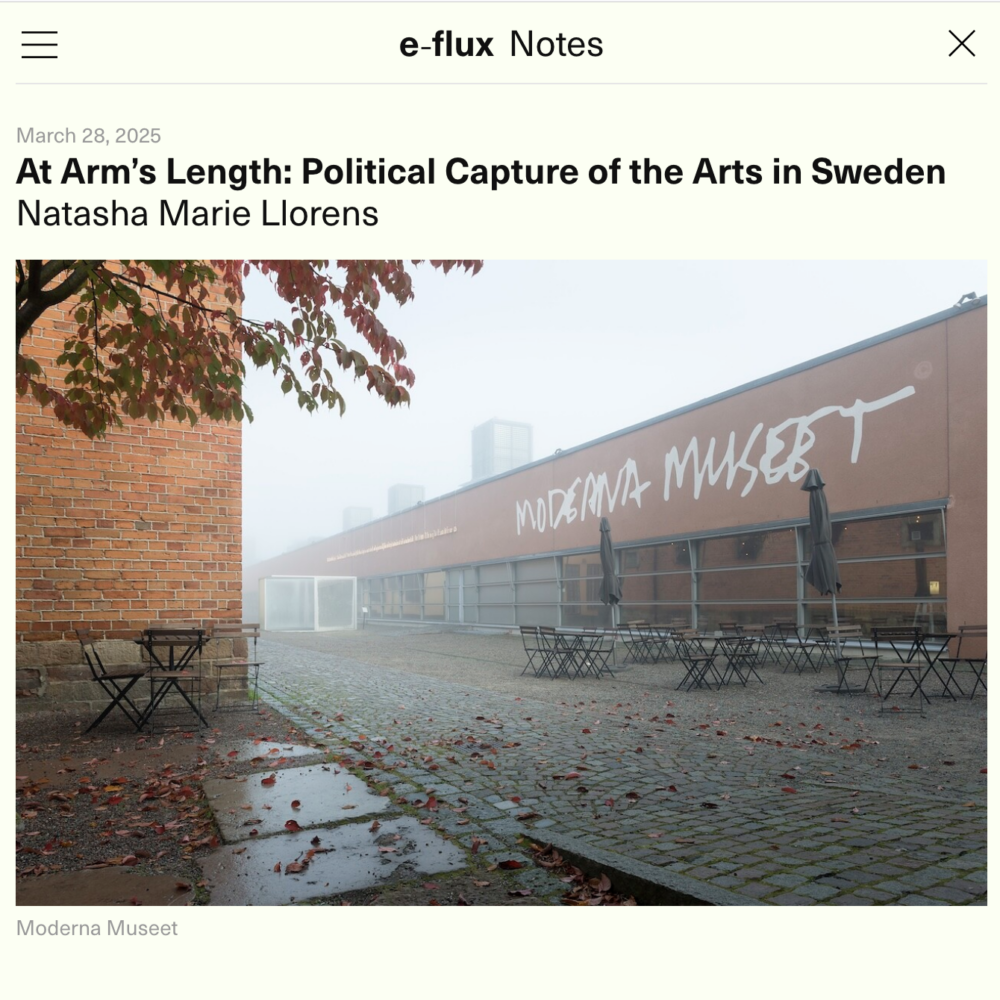
At Arm’s Length: Political Capture of the Arts in Sweden, e-flux.

Read the full article by board member Natasha Marie Llorens on Swedish cultural policy.

“Sweden is that reasonable cousin at Christmas dinner who, when someone starts talking about climate collapse and the rise of fascism, brings the tone of the conversation back within an acceptable emotional range. Around the time the Netherlands was brutally gutting its cultural funding in the early 2010s, Sweden was rearticulating its commitment to a strong, state-supported cultural sector. According to Ann Demeester, the Dutch government justified its financial butchery by painting “artists as elitist, parasitic, sophisticated beggars, living off state subsidies, basically procrastinating.”1 Sweden, by contrast, passed a cultural policy plan in 2009 declaring that “[state-supported] Culture is to be a dynamic, challenging and independent force based on the freedom of expression … Creativity, diversity, and artistic quality are to be integral parts of society’s development”(…).

Article as PDF file Download